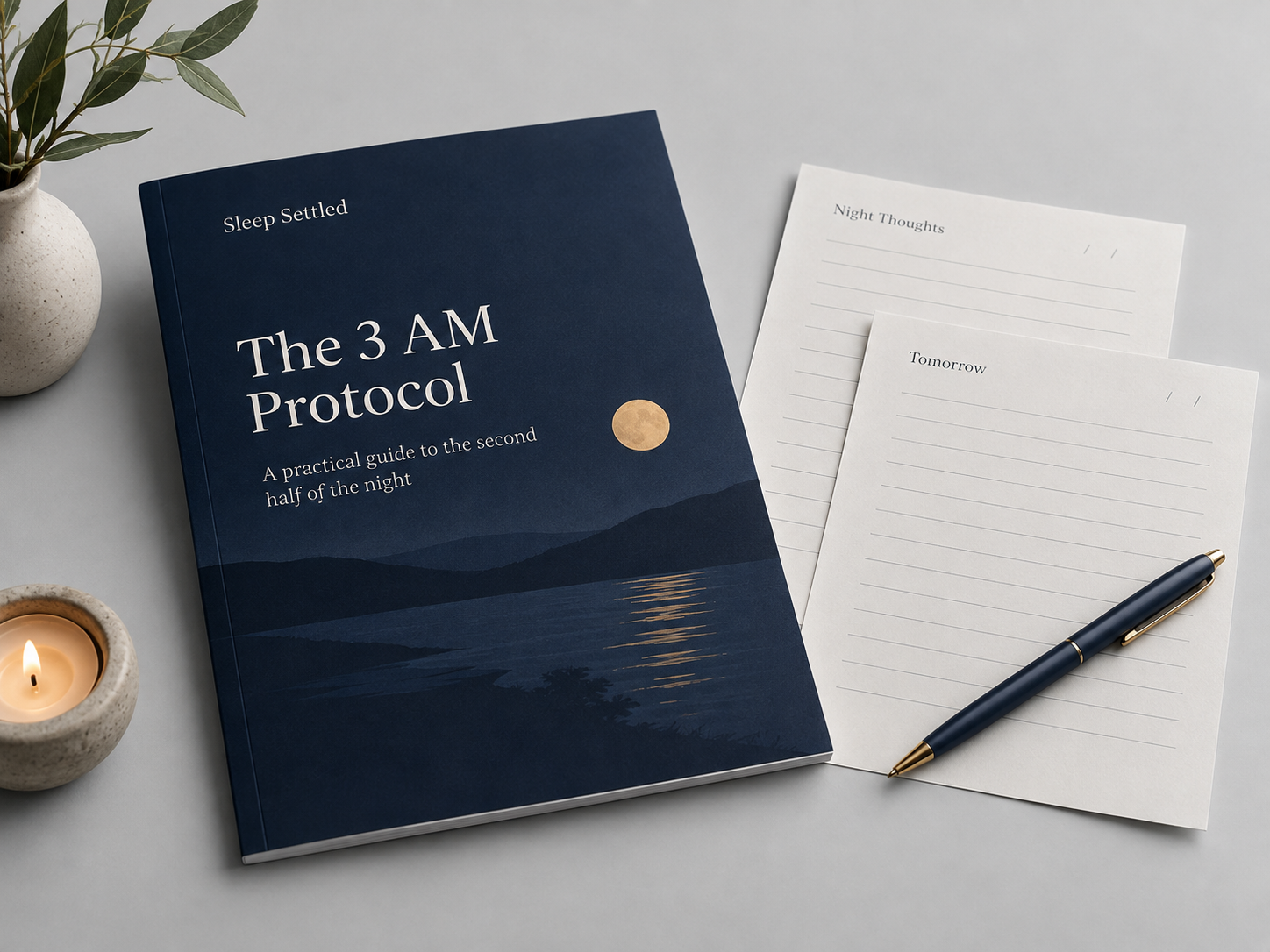
Sleep Settled

For the one in three adults who fall asleep fine, then snap awake in the dark

Why You Wake At 3 AM Has Nothing To Do With Melatonin

And once you understand what it actually is, most people can change it in about four weeks, using a method doctors are told to recommend before sleeping pills.

A digital alarm clock reading 3:47 AM glowing in a dark bedroom, beside a tipped-over pill bottle with tablets spilled on the nightstand

Your eyes open. The room is dark. And you already know roughly what the clock says before you turn your head.

Then the mind starts up. The bills. Something you said four years ago. Whether that ache means anything.

So you do the arithmetic. If I get back to sleep in twenty minutes, I still get four hours.

You don't get back to sleep in twenty minutes.

You lie there until five. Then you doze off about twenty minutes before the alarm, which somehow makes the morning worse rather than better.

And tomorrow you will be a slightly worse version of yourself. Shorter with people you love. Slower at things you used to be quick at. Reaching for the third coffee at two in the afternoon and knowing exactly what that will cost you tonight.

You have already tried the obvious things

Let me guess.

  • Melatonin. Started at 3 mg. You are probably on 5 or 10 now.
  • Going to bed earlier, to catch up.
  • Lying very still with your eyes closed, because surely that is at least resting.
  • Cutting the afternoon coffee.
  • A different pillow. A cooler room. An app that plays rain sounds.
  • Lying in on Saturday to make up the deficit.

Some of it helped a little for a week. None of it lasted.

Here is why. Every single item on that list is aimed at the wrong problem.

The thing nobody told you about melatonin

Melatonin is a timing signal. It is not a sedative.

Its entire job is to tell your brain that the sun went down. That is it. It is the doorbell, not the room.

Which means it is built almost completely around falling asleep.

And falling asleep was never your problem. You fall asleep fine.

So every night, you have been taking something designed for a problem you do not have. Then lying awake at a quarter to four wondering why it did not work.

The doorbell already rang at half past ten. At 3:47 there is nobody at the door.

It gets worse when you raise the dose

Three milligrams stops doing much, so you go to five. Then ten, because that is what the big bottle contains.

But research on melatonin dosing keeps finding the same thing. Doses in the region of 0.3 to 1 mg work about as well as the large ones, with far fewer next-morning effects. A 5 or 10 mg tablet pushes your blood melatonin many times above anything your body would produce on its own.

Two things follow.

The morning fog, because your brain is still receiving a darkness signal at seven.

And a tolerance-like effect, because sustained high exposure appears to reduce receptor responsiveness. Which means you need more. Which means more fog.

You end up sleeping no better and waking up worse.

Now the part that actually matters

Ask the right question and the whole thing changes shape.

The question is not why you wake up.

Everybody wakes up. Not some people. Everybody. Sleep runs in cycles of roughly ninety minutes, and at the boundary between cycles you rise close to the surface. A healthy sleeper does this ten to fifteen times a night and remembers none of it.

A large study of American adults found around 35% wake in the middle of the night three or more nights a week. Roughly a third of the adults around you are having some version of your night.

The ones who are not troubled by it are not sleeping differently from you.

Someone who surfaces at 3:47 and is back asleep in two minutes has roughly the same sleep architecture as someone who lies there until five. Only one of them believes they have a sleep problem.

The question was never why you wake up.

It is why you stay awake.

And that has a specific, physical cause

Three things converge in the small hours, and none of them is mysterious.

Your sleep pressure has largely been spent, because most of it discharges in the first few hours. Your body clock has already started the morning, with cortisol climbing on its own schedule toward a peak shortly after you get up. And your sleep architecture has gone light, with more of the fragile stages and less of the deep stuff that nothing can wake you from.

That is why the small hours are a thin place in your night.

A chart showing sleep pressure falling through the night while circadian wake drive rises, the two lines crossing shortly before 3 AM
Sleep pressure falls while your body clock starts the morning. Where they cross is where your night gets thin.

But it still does not explain the forty minutes.

The forty minutes is something your brain learned.

What your bed has been teaching you

Your brain is extremely good at learning associations, and it does it without asking you.

For someone who sleeps well, the bed is a powerful sleep cue. Decades of getting in and losing consciousness within twenty minutes have made it so.

Now think about what your bed has been teaching you.

Perhaps two hundred nights this year of lying in it awake. Worrying in it. Doing arithmetic about hours in it. Watching the ceiling.

Your brain has been diligently learning exactly what you have been feeding it.

Bed means being awake and worrying.

This is why you can fall asleep in the armchair at nine o'clock and then be completely alert the moment your head hits the pillow. The armchair has no history. The bed has a year of it.

Clinicians call this conditioned arousal. It is the single most common reason a sleep problem outlives whatever started it.

And because it is learned, it can be unlearned.

There is a treatment for this. You have probably never been offered it.

It is called cognitive behavioural therapy for insomnia, and it is not what it sounds like. It is not talking about your childhood. It is a structured, practical protocol with specific rules and specific numbers.

Here is what matters about it.

The American College of Physicians and the American Academy of Sleep Medicine both recommend it as the first thing to try for chronic insomnia. Before sleeping pills.

Not as an alternative for people who dislike medication. As the first-line treatment. It performs about as well as sleeping pills in the short term and considerably better over the long term, because when you stop taking a pill the problem returns and when you finish this it tends not to.

So why has nobody offered it to you?

Because it takes four to eight sessions with a trained therapist, there are nowhere near enough of them, and a prescription takes ninety seconds to write. There is a well-documented gap between how well this works and how few people can actually get it.

How short is the supply? Fewer than 800 clinicians in the entire country are certified to deliver it. Barely half of the ones who exist take insurance at all, and Medicare acceptance is close to non-existent. One survey of providers found a single practitioner nationwide accepting it.

So if you are over sixty and you asked your doctor about this, the honest answer was probably a prescription. Not because the prescription is better. Because the alternative is not available to you.

The protocol itself was never the secret. It is written down in the same clinical manuals every sleep clinic works from. The bottleneck is people, not information.

That gap is the reason this book exists.

The 3 AM Protocol

A four-week guided programme for the second half of the night

Six modules you work through week by week, a nightly diary that does the arithmetic for you, and a reference library you can reach from day one. The complete written programme is included as a printable PDF too, if you would rather have it on paper.

The 3 AM Protocol, a 62-page PDF programme, shown with sample interior pages including the printable sleep diary
The printable workbook, included with the course. The diary and the 3 AM card are designed to be printed.

Module 0: Start Here. How the programme works, the safety screen, and an honest account of what each week will feel like.

Module 1: Why You Wake. Four lessons on what is actually happening between two and four in the morning. Sleep pressure, the cortisol climb, the architecture shift, and the three coping habits that quietly keep the problem alive.

Module 2: Before You Begin. The screening chapter, and one week of simple record keeping that everything else is calculated from.

Module 3: Week One, The Window. The app takes your diary and calculates your sleep window. This is the most powerful week and the hardest, and the lessons tell you exactly what each day will feel like so you do not quit on day four like most people do.

Module 4: Week Two, What To Do At 3 AM. The fifteen-minute rule and the five rules of stimulus control. This is the week that unteaches your bed.

Module 5: Week Three, The Mind At Night. The four beliefs that keep people awake, the constructive worry technique, and three body-based methods for a racing mind.

Module 6: Week Four And Beyond. Widening the window, the titration table, what to do after a bad night, and how to keep it.

The Reference Library, open from day one. Menopause and the night. Alcohol, caffeine and the evening meal. Light, temperature and the bedroom. And an honest chapter on supplements that ranks the evidence and tells you which ones are worth your money.

The Tools. A nightly sleep diary that calculates your sleep efficiency for you and tells you what to change each week. A chart of your sleep against your days. The printable 3 AM card. And the complete programme as a PDF to keep.

And the sources. Every claim in the book is referenced back to where it came from: the clinical guidelines, the screening tool, the dosing research. If you want to check something before you act on it, you can.

You keep access for good. No subscription, no monthly fee, no app to download. It runs in your browser on a phone, a tablet or a computer.

This is not for everyone, and I would rather tell you now

Do not buy this if you are looking for something to take. There is no supplement here. There is a schedule, a set of rules, and four weeks of doing them.

Do not buy this if you cannot commit to a fixed wake time. Seven days a week, weekends included. That one rule holds the entire structure together, and without it nothing else in the book will work.

Do not buy this if you want week one to be easy. It is not. You will be staying up later than you want to and you will be tired by Wednesday. The book says so on the page rather than in the small print.

And there are people who should not run the core technique at all without a doctor. The programme involves a temporary, deliberate reduction in time spent in bed. That is safe for most people and it is not safe for everyone. If you have bipolar disorder, epilepsy, untreated sleep apnoea, a parasomnia, or you are at risk of falls, Chapter Five tells you plainly to speak to a doctor first and gives you an alternative route through the book.

I would rather lose the sale than have somebody skip that page.

What this costs

A course of the clinical version runs four to eight sessions with a specialist therapist. In the United States that works out somewhere between $800 and $2,000 out of pocket, with one published estimate putting a standard six-session course at around $1,000.

That is not a criticism of therapists. It is what an hour of a trained clinician's time costs, and if you can get it, take it.

This is the same protocol, written to be run at home, for $37.

The 3 AM Protocol, a 62-page PDF programme, shown with sample interior pages
A before and after timeline showing fragmented sleep across eight and a half hours in bed, compared with consolidated sleep across seven hours forty minutes
The same person, four weeks apart. The 50-minute wake at 3:30 becomes a 12-minute one, while total sleep stays about the same.
$37

one time. Lifetime access, no subscription.

Not $37 a month. Once.

The guarantee

Sixty days. Any reason, or none.

Four weeks to run the protocol and four weeks to see whether it held. If it has not changed your nights, email hello@sleepsettled.com and you get your money back. Keep the book.

I am not going to pretend that is generous. It is the only sensible way to sell something like this, because a programme that does not work for you should not be something you paid for.

Why this exists

I am not a doctor and this book does not pretend otherwise.

What I did was read the clinical manuals that sleep clinics work from, find that the protocol inside them was clear, specific and completely inaccessible to most people, and write the version I wanted at four in the morning.

Every claim in the book is sourced. The appendix lists where each one came from, so you can check the parts that matter to you rather than taking my word for it.

That is the whole story. There is no origin myth here and no clinic behind me. There is a protocol that works, written down plainly, for people who cannot get an appointment.

Sleep Settled
Written anonymously by design.

FAQ

How is this different from every other sleep book?

Most sleep books are a list of tips. This is a protocol with numbers. You calculate your own sleep window from your own diary, you follow a schedule, and you adjust it weekly against a table. It is closer to a treatment plan than to a book of advice.

I have had this for years. Does that matter?

Not much, and this may be the most surprising thing in here. The behavioural approach targets what is keeping the problem going now, not what started it. It is routinely used for problems that have run for decades.

Will I have to give up my sleeping tablets?

No, and please do not stop any prescribed medication on your own. The book is explicit about that. Talk to your doctor. The protocol runs alongside.

I am in menopause. Is this relevant?

Very. Sleep problems affect somewhere between 16 and 47% of women during perimenopause, and there is a full chapter on it, including the protocol adjustments and how to prepare for the conversation with your doctor.

How long until something happens?

Most people notice the first change somewhere between night five and night ten. Week one is usually worse before it is better, which the book warns you about repeatedly so you do not read it as failure.

How does it work?

It is an online course you log into. Six modules, each broken into short lessons you read in a few minutes. The diary and the weekly calculations happen in the app, so you never have to work anything out yourself. The full written programme is also included as a PDF you can print.

Do I need to download an app?

No. It runs in a web browser on a phone, tablet or computer. Nothing to install.

Is this a subscription?

No. You pay $37 once and keep access. There is no monthly fee and nothing to cancel.

Do I get everything straight away?

Modules 0, 1 and 2 open immediately, along with the reference library and the tools. The four protocol weeks open one at a time, because Week Three is calculated from the diary you keep in Week Two and reading ahead leads people to start the protocol with the wrong numbers. If you would rather go at your own pace, there is a link on each module to open it early.

Is this medical advice?

No, and the book says so on its first page. It is an education programme. It does not diagnose or treat anything, and it tells you clearly when to see a doctor instead.

Close

You have two options tonight.

The first is the one you have already been running. Another half milligram. Another early bedtime to catch up. Another 3:47 spent doing arithmetic about how many hours are left.

The second is four weeks of doing something specific, with a protocol that doctors are told to reach for before they reach for the prescription pad.

$37. Sixty-day guarantee. Download in the next two minutes.

P.S. If you take one thing from this page and never buy anything, take this. Melatonin is aimed at falling asleep, and falling asleep is not your problem. Stop raising the dose. It is making your mornings worse and it was never going to fix your nights.

P.P.S. The screening chapter is Chapter Five and it is fifteen minutes. One very common condition produces exactly your symptom, will not respond to anything behavioural, and is badly underdiagnosed. If that turns out to be you, the book will have paid for itself by sending you to the right place.

Individual results vary. This programme is educational and is not medical advice, and is not intended to diagnose, treat, cure or prevent any disease. Speak to a doctor about persistent sleep problems.